Louise van Rhyn: Passion for Education

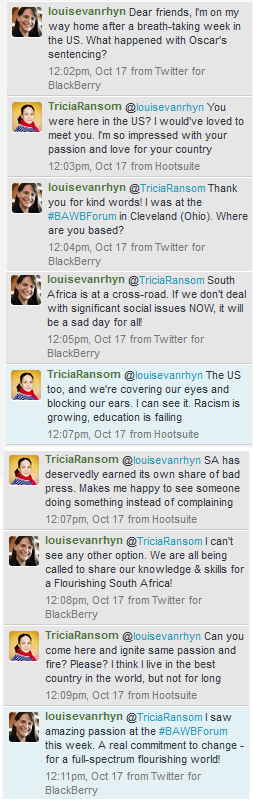
I’ve never met Louise in person – I only know her from Twitter. She lives in South Africa, and has a love, passion, and excitement for her country that you rarely see. This blog post exists because of  a conversation she and I just had (minutes ago) on twitter.

Before I get to that, let me tell you what I know about Louise – she’s wonderful. Her focus is on improving education in South Africa. For everyone. Her “bold and audacious vision” is: Quality education for all children in South Africa by 2022

To see how she’s actually achieving her vision, instead of just yakking, go to her website, Partners for Possibility.

Here is our conversation:

Conversation with Louise

Posted in learning, Teaching | Tagged , , , , , , | Leave a comment

Technology and Classrooms

I recently read a blog post by David Kelly about technology in the classroom titled “Why Technology Belongs in a Classroom“.

David was responding to a blog post by Clay Shirky, “Why Clay Shirky Banned Laptops, Tablets, and Phones From His Classroom“. I read that article too.

In essence, Clay Shirky, who teaches theory and practice of social media at NYU, has banned technology from his classroom. David Kelly, who is part of the eLearning Guild, disagrees with Shirky.

What you are about to read is my comment, unedited, that I left on Shirky’s article:

Interesting. You begin with the statement, “I teach theory and practice of social media at NYU”. Notice the word theory. Towards the end you mention “hard thinking (our spécialité de la maison, here at college)”.

I argue that in your area of expertise, Social Media, hard thinking is what happens when people are on their devices.

Yes, people are more distracted today than ever. You mention that the only variable that’s changed in your classroom is technology.

I challenge you to rethink what a classroom is. Is it a place where the same material is taught in the same way as it was 50 years ago? Or is it an opportunity to use technology to grab people’s attention and immerse them in a subject?

Rather than lecturing about the dates in the Crimean war, why not have people re-create what led up to it? Assign them to teams, each a country, with certain resources and agendas. It’s like a living version of Risk.

To me, teaching is about engaging. Yes, technology is designed to be engaging. So let’s design teaching to be engaging. Use blips, sounds, instant notifications, badges, personalization, colors, music, sounds in your teaching.

Teaching is also about motivating. I can push information out to people all day long whether or not they have a laptop, tablet, phone, google-glass, google watch, pen and paper, or chalkboard slates.

But why are they there? Is it to fulfill a requirement to get their degree? Is it to learn more about the subject? Is it because their friends are taking the class?

If someone isn’t internally motivated, it doesn’t matter what I do. They’ll tune out. I was in undergrad during the 80s. I used my time in lectures to do other homework, write letters, day dream, scribble, learning to write left-handed, and people watching out the window.

Distraction is not a new problem. What is new is how we must adapt to overcome the sheer amount of distraction. And external forces can’t do that. People must be intrinsically and internally motivated to ignore the distraction and focus on something else.

Yes, people need to learn to pay attention at times and they need to learn how to focus regardless of distractions.

In the real world, when they get their first jobs, they’ll be distracted. Trust me. I’m writing this from my open cube at work listening to four conversations and seeing multiple computer screens.

Help your students prepare for the reality they’ll face. Help your students learn to be a good co-worker. Help your students learn to manage their time. Help your students to feel a personal connection with your subject.

PS: by the way, my job is to teach white-collar workers in corporate America. I have a Master’s Degree in Training & Development/Human Performance Improvement (while I was working full-time, and with my own money – no loans). This is my passion. I dream about my work. I love what I do. And I love it even more when I break through the distractions and get the “ohhh…I get it!”.



Posted in Teaching, Technology | Tagged , , , , , , , , | Leave a comment

Picasso and Me

“A picture used to be a sum of additions. In my case, a picture is a sum of destructions.” ~Pablo Picasso

“A course used to be a sum of added information. In my case, a course is a sum of deducted information.” ~Tricia Ransom

Posted in learning | Tagged , , | 2 Comments

Show Your Work: SMEs

We all work with SMEs. Sometimes it’s wonderful, sometimes painful. Here are my tips from 2010. I still stand by these:

My philosophy is that SMEs are busy and my job is to minimize my impact on their time while maximizing their focus on the need-to-know information vs. nice-to-know.

I need to have the need-to-know, and that is my sole focus. My job is to get my SMEs to understand need vs. nice. [jump to 2014: If I were writing this today, I’d say, “doing vs. knowing”. What do they need to do?]

My SME work is getting them to understand need vs. nice. [2014 Tree here again…”My SME work is getting them to understand doing vs knowing.”]

I like to have an introductory meeting with the SME where I ask what their preferred method of communication is (phone, email, face-to-face), how long they can go before getting antsy, and what I think the time impact will be. I do this even if they’ve been “volunteered” by their manager.

Before I meet with any SME, I send an email with a list of the questions I’m need to have answered. If they respond back to me with the answers I use the scheduled time for deeper probing.

I research everything to get myself up to speed on terminology, processes, etc. This helps build my credibility. They know I’m always prepared and that I am only coming to them for something I can’t find on my own.

I over-schedule meetings!! If I know it’s going to take 30 minutes, I schedule 60. That way we’re done early, they think I’m terribly efficient and they don’t mind accepting future meeting invites from me.

If we’re done early, I end the meeting and let them go. I NEVER EVER just fill time because we have time.

I focus, focus, focus them on need vs. nice to know. It’s rare that I’m going to include nice-to-know in training (learners don’t often remember it). I’m always saying “how does this work for 80% of the people? The other 20% aren’t the norm, and this training doesn’t cover that. What do 80% of the people NEED to know to do 80% of their job?” [And again, in 2014 I replace the “need” with “do”, “nice” with “know”. See the change?
I focus, focus, focus them on doing vs knowing. It’s rare that I’m going to include knowing in training (learners don’t often remember it). I’m always saying, “what do 80% of the people DO? The other 20% aren’t the norm, and this training doesn’t cover that. What do 80% of the people need to do to complete 80% of their job?”]

I keep asking “If there was one thing, and only one thing that learners need to remember from this training what is it?”

I also ask, repeatedly, “What is the question that you keep having to answer over and over again?”

If they’re reviewing content, I tell them “these are your words, just re-ordered to allow for adult learning theories and concepts”. SMEs are people too, and very very VERY sensitive about their creations and words!

When I ask them to review something, I highlight/post-it note/call out the areas where I absolutely need them to answer a question or give me input. I tell them, “It would be ideal if you could review everything, but at the bare minimum please look at those areas”.

If I’m asking them to create content, I create a sample and a template. I make it very structured. “Put step 1 here. Step 2 there. Make the steps a single sentence that starts with a verb. Give me access to the system, and I’ll get the screenshots myself!”

Finally, I’ve become a master at the cube-lurk, random emails or IMs, or just anything that puts my name/face in the front of their minds. Usually just seeing me reminds them that I need something from them.

These are my SME tips…what do you do?

Posted in Show Your Work | Tagged , , , , | 1 Comment

Part II: Learning About Learning From My Ancestors — Grandma

An old draft post I found from November 2009.

This is part II in my series about how/why I’m so focused on learning. It’s a learned trait – passed from my great-grandmother to my grandmother to my mom to me. This section focuses on my grandma.

The writing is choppy, and sometimes disjointed. I wanted to get the feelings and words down, and to convey the emotion that I feel. If I were speaking aloud about Mama, Grandma, and Mom, I wouldn’t be polished and flowing. And I won’t be here either.

This is my story of Callie, my grandmother. I wish I could have known her better.

Grandma

Me, Mom, and Grandparents

This is my grandma, Callie Miller Murphy along with me and my mom. She was Mama’s first-born and only daughter, and I didn’t know her that well.

What I do remember is that she was always smiling, and that she and grandpa called each other Mother and Daddy – never their names of Jake and Callie.

Grandma graduated high-school from Wendell Phillips in Chicago, the same as her father. In fact, grandma was friends with the great poet, Gwendolyn Brooks, but grandma’s story was very different from hers.

My grandparents met at a party, and within a year of being married, they were parents to my mom. It was the middle of the depression, and times were hard for everyone, especially if you were black. My grandfather was very fair-skinned, and could pass for white, which he did occasionally to find work. Grandma was primarily a stay-at-home mother.

Miller Family House 1920-1973

This is the house where my grandparents lived with Mama and Papa when they first married. My mother and her sister were born on a couch here. One of grandma’s brothers married the girl who lived downstairs. A member of the Miller family lived here from 1920 to 1973, and it’s still standing (this picture was taken in 2009).

The stories I remember most about grandma are these:

  • She would organize the kids in the housing projects (they lived in Ida B. Wells when it was first built), and take them to museums and outings to downtown. She used to tell them that just because they lived in the projects didn’t mean that they couldn’t appreciate art.
  • She made my mom take piano and violin lessons (which would amuse you if you knew my mom, as she is not the most musical of people).
  • She insisted that they sit down to dinner together as a family every night, and eat off of cloth tablecloths and napkins which had to be ironed.
  • She used to tell my mom that if you carry yourself as a lady, you were a lady.
  • She loved to dance, and before she married my grandfather, she used to win dance contests in the clubs around Chicago. In fact, she won so many, she was barred from them.

At the end of her life, grandma couldn’t walk and was in a wheelchair. She was still smiling.

Here is Callie, my grandmother. I wish I could have known her better.248524_2057005670964_5705636_n


Posted in family, History, learning | Tagged , , , , , | Leave a comment